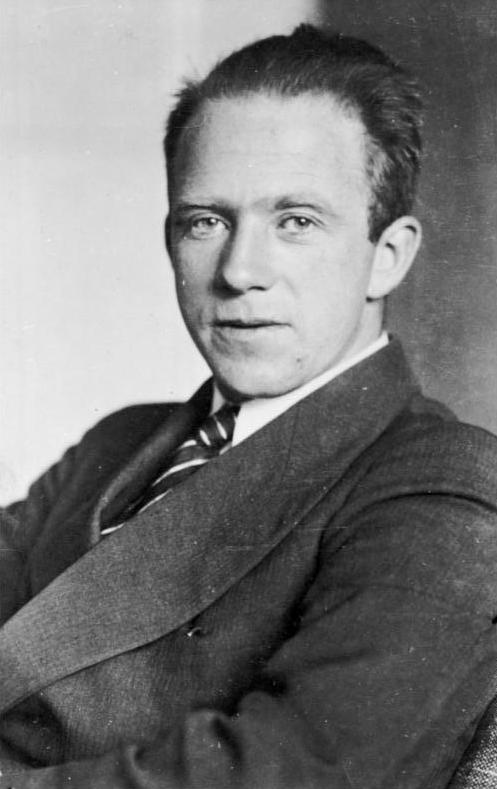
Werner Heisenberg
- Prize
- Nobel Prize in Physics — 1932for the creation of quantum mechanics, the application of which has, inter alia, led to the discovery of the allotropic forms of hydrogen
- Citizenship
 Weimar Republic
 German Empire
 West Germany
 Nazi Germany
- Languages
- German
- date of birth
- 12/5/1901
- place of birth
- Würzburg
- date of death
- 2/1/1976
- place of death
- Munich
- Lived
- 74 years
See more
- occupation
- non-fiction writer
- university teacher
- nuclear physicist
- physicist
- mathematician
- theoretical physicist
- mountaineer
- field of work
- theoretical physics
- mathematics
- educated at
- Maximiliansgymnasium München
- start time: 1911
- end time: 1920
- LMU Munich
- start time: 1920
- end time: 1923
- Maximiliansgymnasium München
- employer
- Humboldt-Universität zu Berlin
- start time: 1941
- end time: 1941
- University of Göttingen
- start time: 1924
- end time: 1924
- Leipzig University
- start time: 1927
- end time: 1941
- University of Copenhagen
- start time: 1926
- end time: 1927
- University of St Andrews
- start time: 1955
- end time: 1956
- Max Planck Institute for Physics
- start time: 1946
- end time: 1970
- LMU Munich
- start time: 1958
- end time: 1958
- German nuclear program during World War II
- start time: 1941
- end time: 1945
- Humboldt-Universität zu Berlin
- work location
- Munich
- Copenhagen
- Leipzig
- Göttingen
- Berlin
- member of
- Royal Society of London
- Japan Academy
- start time: 1/12/1965
- Royal Swedish Academy of Sciences
- Royal Netherlands Academy of Arts and Sciences
- National Academy of Sciences
- start time: 1961
- Royal Prussian Academy of Sciences
- Accademia Nazionale dei Lincei
- start time: 10/5/1947
- Göttingen Academy of Sciences and Humanities in Lower Saxony
- Saxon Academy of Sciences and Humanities
- start time: 7/1/1930
- end time: 10/1/1942
- Saxon Academy of Sciences and Humanities
- start time: 10/1/1942
- American Academy of Arts and Sciences
- American Philosophical Society
- start time: 1937
- German Academy of Sciences at Berlin
- German Academy of Sciences Leopoldina
- start time: 1933
- Göttingen Eighteen
- Bavarian Academy of Sciences and Humanities
- Bavarian Academy of Fine Arts
- Romanian Academy
- Pontifical Academy of Sciences
- doctoral student
- Viktor Alexander Garten
- Fritz Kluge
- Gerhard Börner
- Hans Werner Fiedler
- Edwin Karl Gora
- Detlof Julius Alexander Ponsonby Lyon
- Hildegard Geest
- Gerhard Martin
- Willem van der Grinten
- Horst Müller
- Otto Günther
- Friedwardt Winterberg
- Felix Bloch
- Wilhelm Macke
- Ivan Supek
- Ludwig Bewilogua
- Werner Güttinger
- Alfred Recknagel
- Peter Mittelstaedt
- Wilhelm Brenig
- Wang Foh-San
- Șerban Țițeica
- Richard John Eden
- Hermann Arthur Jahn
- Rudolf Peierls
- Carl Friedrich von Weizsäcker
- Edward Teller
- Kurt Symanzik
- Bernhard Kockel
- Hans Heinrich Euler
- notable work
- Heisenberg group
- uncertainty principle
- isospin
- Kramers–Heisenberg formula