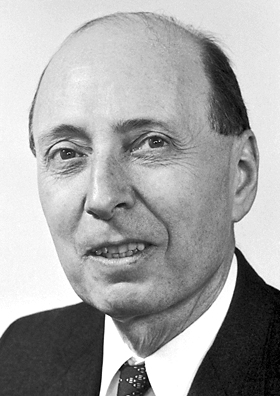
Eugene Paul Wigner
- Prize
- Nobel Prize in Physics — 1963for his contributions to the theory of the atomic nucleus and the elementary particles, particularly through the discovery and application of fundamental symmetry principles
- Citizenship
 Hungary
 United States
- Languages
- English, Hungarian
- date of birth
- 11/17/1902
- place of birth
- Budapest
- date of death
- 1/1/1995
- place of death
- Princeton
- Lived
- 92 years
See more
- occupation
- university teacher
- nuclear physicist
- physicist
- mathematician
- theoretical physicist
- field of work
- physics
- educated at
- Technische Universität Berlin
- start time: 1920
- end time: 1925
- Fasori Gimnázium
- end time: 1919
- Technische Universität Berlin
- employer
- Manhattan Project
- start time: 1942
- end time: 1945
- University of Göttingen
- start time: 1927
- end time: 1928
- Leiden University
- start time: 8/8/1956
- end time: 12/3/1957
- Princeton University
- start time: 1930
- end time: 1936
- Princeton University
- start time: 1938
- end time: 1942
- Princeton University
- start time: 1946
- end time: 1971
- Technische Universität Berlin
- start time: 1928
- end time: 1933
- Oak Ridge National Laboratory
- start time: 1945
- end time: 1946
- University of Wisconsin–Madison
- start time: 1936
- end time: 1938
- Manhattan Project
- member of
- Royal Society of London
- Royal Netherlands Academy of Arts and Sciences
- Hungarian Academy of Sciences
- National Academy of Sciences
- start time: 1945
- American Association for the Advancement of Science
- Göttingen Academy of Sciences and Humanities in Lower Saxony
- American Academy of Arts and Sciences
- American Philosophical Society
- start time: 1944
- American Physical Society
- doctoral student
- William Tout Sharp
- Ralph Zvi Roskies
- Theodore Duddell Newton
- Francis Joseph Narcowich
- Rajmund Lewis Somorjai
- George Abraham Snow
- Conyers Herring
- Leonard Eisenbud
- Joseph O. Hirschfelder
- Abner Shimony
- Victor Weisskopf
- Fred Tappert
- Marcos Moshinsky
- Edwin Thompson Jaynes
- John Bardeen
- Frederick Seitz
- notable work
- Wigner's theorem
- The Unreasonable Effectiveness of Mathematics in the Natural Sciences